May
2010
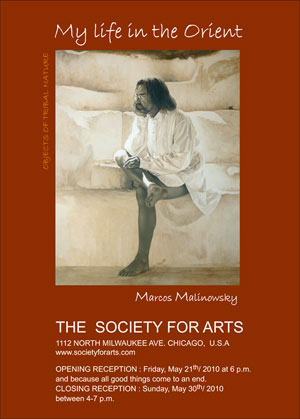
MARCOS
MALINOWSKY MY LIFE IN THE ORIENT
an
exhibition & silent auction of the objects of tribal nature
May 21-30, 2010
 ...........
In
1979 I opened Studio 702, a company that specialized in creating
objects of art along with utilitarian designs, primarily out of
glass and acrylic. These materials are sometimes also known as Lucite
or Plexiglas. In October of 1987, in the midst of my strong fascination
with these materials, I went to Poland to make the "Acrylic
& Glass" exhibition. The event became an instant hit. The
opening was standing room only, and everything was sold in just
a few days.
In
retrospect, I believe that one of the major reasons for the success
was the fact that all of my work was done in two mediums that were
not widely known or used at the time. Poland was just emerging from
the dark shades of communism, eager to embrace capitalism along
with modern technology. Perhaps, apart from substance alone, most
of the artists and art lovers who viewed this presentation were
impressed by the heavy gauges of glass and thick acrylic, which
opened new horizons of imagination and possibilities.
Why
do I bring a long forgotten event to your attention today?
I
believe there is an interesting similarity between the "Acrylic
and Glass" event that took place thirty years ago and the new
soon to be open "My Life in the Orient" exhibition at
The Society for Arts in Chicago. However, before I explain this
connection, let me ask you a question. If you live in the Chicago
area, how often do you get a chance to see women dressed in tribal
outfits working long hours on the edge of a sidewalk, stitching
or embroidering vibrant colors on pieces of silk, cotton or hemp?
You
would probably say never, and this is well understood.
After
all, in your city almost every slightly unusual activity requires
a permit, license or certification. This method of control does
not apply however to the life I now live in the city of Chiang Mai
located in northern part of Thailand, near the famous Golden Triangle
where this "country of smiles" shares borders with Laos
and Burma.
Here,
in Chiang Mai -along with thousands of resident Thai people, tourists
from the rest of the world, temples, colorful markets, fabulous
places to eat, and year round almost perfect weather - I've chosen
to stay "permanently" for the last several years.
There
is also another aspect of life here which has gradually become an
object of my fascination. Northern Thailand is home to many interesting
and colorful ethnic minorities, known as the hill tribes. Most of
them have migrated here during the last hundred years from Asian
interiors and have largely preserved their way of life. This preservation
makes them a fascinating cultural phenomena. They prefer living
high in the mountains, shy away from the outside world, yet they
often come into the city to sell their ethnic products. Unlike you,
I see many women embroidering or stitching very beautiful ornaments
on the streets of my town and although I see this process practically
every day it sill fascinates me.
What
is then the connection between the event from the past and my upcoming
exhibition?
Just
like years ago, I captured the interest of Poles with my fascination
of acrylic and glass, now I like to do same thing with you by bringing
to your attention the world whose existence you most likely are
unaware in its full volume.
Hope
that some of you will share my fascination.
Thank
you and see you at the show,
Marcos Malinowsky
|